Key takeaways
- Predict, change one variable and explain the observation.
- Use simulations alongside safe physical practical work.
- Check grade, subjects and available published labs before subscribing.
The short answer
A virtual lab is an interactive environment for observing a model, changing a variable and interpreting the result. Its value comes from guided investigation and feedback, not simply from displaying an attractive 3D object.
What the Research Says
de Jong, Linn and Zacharia discuss the strengths of physical and virtual laboratories and the potential of combining them. Their review does not establish a universal 30% improvement, and a simulation’s usefulness depends on its design, guidance and the learning task.
Distinguish a virtual lab from a video
A video presents a recorded explanation, while an interactive lab lets the learner make a choice and observe how the model responds. That choice could involve changing a breathing parameter, comparing measurements or arranging a musical rhythm, provided the activity explains what the model represents and where its limits lie.
Ask the learner to state a prediction before touching a control, then describe the result using evidence rather than saying only that the animation moved. A useful lab ends with a question or explanation that reveals whether the learner understood the relationship being investigated.
Pure Sciences: use a model to explain a relationship
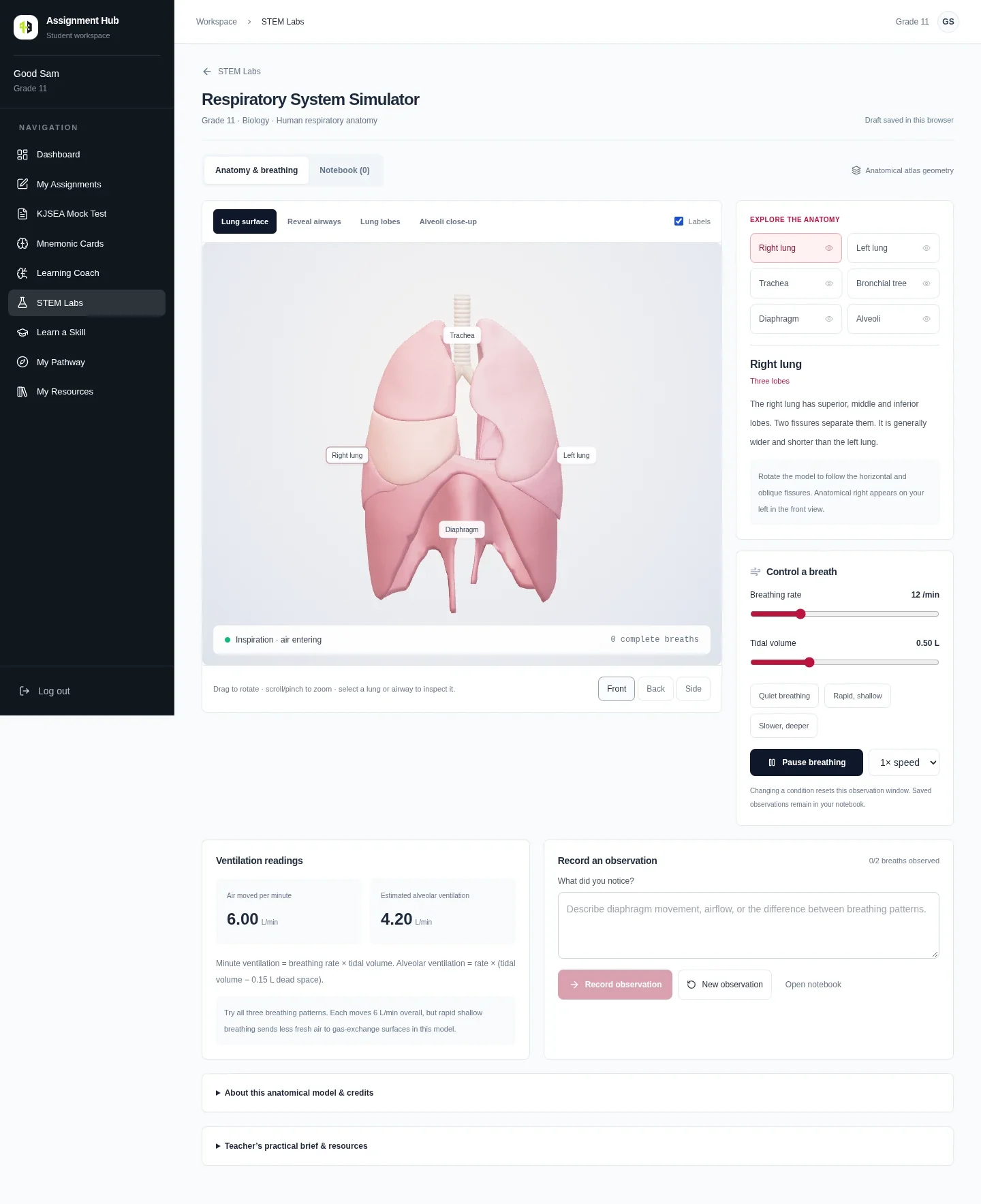
A respiratory model can help connect visible movement with a discussion of breathing and gas exchange, but the lungs are not simply balloons that move because a slider was dragged. Ask which anatomical structures are represented, what the control changes and which physiological processes the simplified model leaves out.
Rotate the view when it helps identify a structure, record an observation and connect it to a curriculum question afterwards. The purpose is to make an explanation inspectable; a polished rendering alone does not demonstrate that the learner can apply the idea in an unfamiliar question.
Technical and Applied Sciences: investigate a practical problem
Technical learning can use simulated components, measurements and design constraints to ask what happens when one parameter changes. Applied-science investigations connect a model to a practical need such as agriculture or measurement, with a reasoned interpretation of the output instead of random adjustments until something looks impressive.
Real tools, materials and safety procedures still need supervised practical teaching, so a virtual activity should prepare for or extend that experience. Confirm the published module and its scope, because a category label does not guarantee that every technical or applied subject already has a complete interactive investigation.
Sports and Music: compare, create and reflect
Sports Science activities can connect movement, muscle behaviour and physiological responses with a prediction and a recorded observation. The model must distinguish what it simulates from an actual measurement of the learner, and it should not be treated as medical advice, a fitness diagnosis or a safe substitute for coaching.
Music activities let learners explore rhythm, instrument choices and musical organisation by listening, changing an arrangement and explaining the result. These are different kinds of practice, so use the public lab previews to inspect the experience before assuming every featured workspace is an identical 3D science model.
Follow a five-step investigation routine
Begin with a question and a prediction, change one setting at a time, and record enough observations for a fair comparison. Ask the learner what stayed constant and why that matters, since changing several controls together can produce an attractive result without showing which change caused it.
Finish with a short explanation, then attempt a question without the model open to check what can be recalled independently. The topic-test guide explains how a later retry can connect an engaging investigation with a more durable understanding of the underlying concept.
Choose access that matches the learner
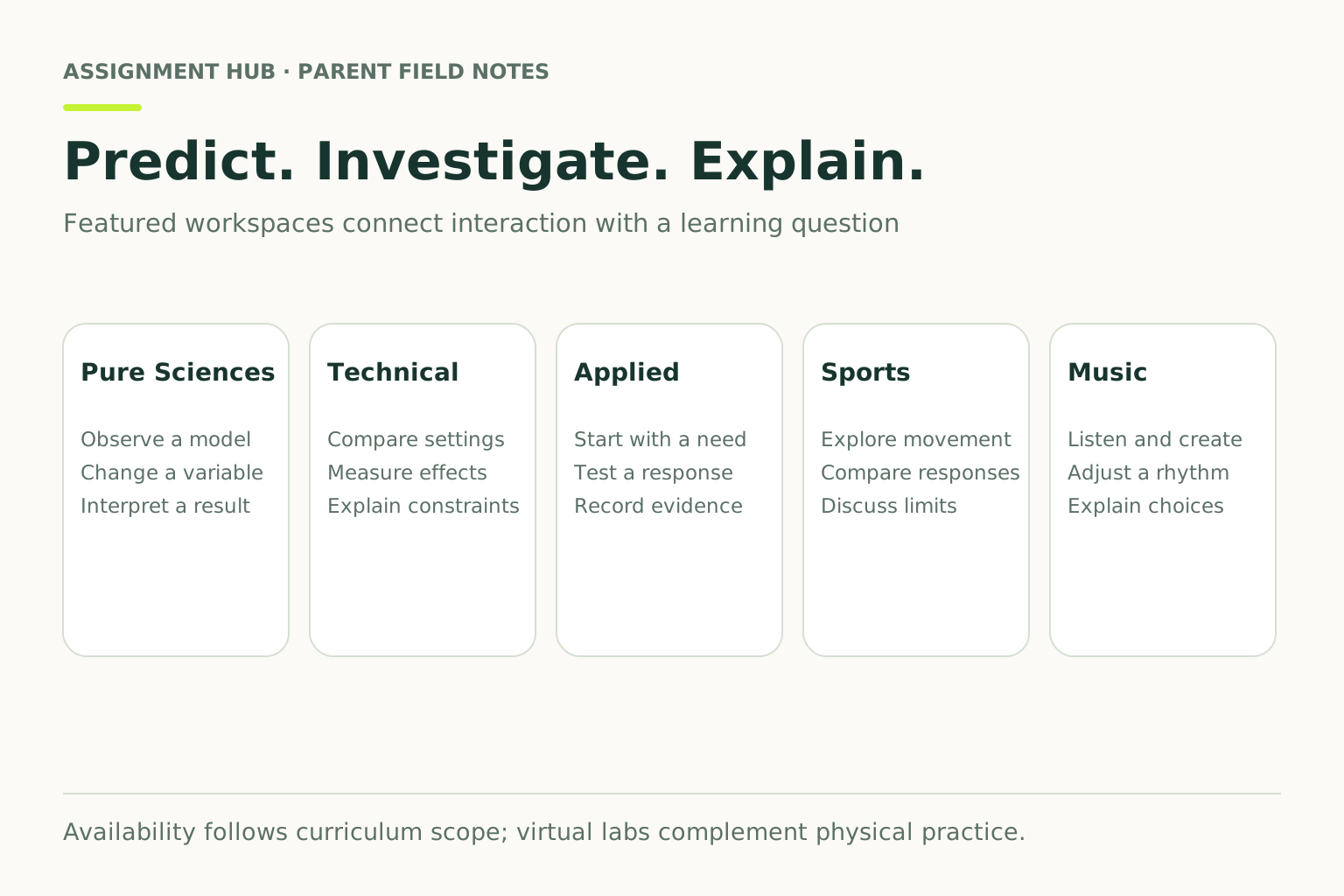
Assignment Hub offers featured Pure Sciences, Technical, Applied Sciences, Sports and Music workspaces within a broader lab system. Availability depends on grade, pathway, track, enrolled subjects, published content and access conditions; a learner should not expect every category to appear in every account.
Start with the public previews, then check the workspace after signing in and ask about any specific subject you need before paying. On a shared phone, use a stable connection, keep other tabs light and switch to the written explanation when a device cannot comfortably render an interactive model.
Look for evidence beyond engagement
An enjoyable activity can motivate practice, but ask whether the learner can explain the result, identify a limitation and transfer the idea to another question. Those outcomes provide better evidence of usefulness than time spent rotating a model or the number of buttons clicked during a session.
Combine lab observations with teacher feedback and the weekly study planning guide so that practical exploration supports the next learning goal. A virtual lab adds another way to investigate an idea; it does not automatically replace experiments, qualified teaching or formal assessment.
Sources and practical resources
Questions parents ask
Can a virtual lab replace physical practicals?
No. It can prepare for or extend practical work, but handling equipment, observing real materials and learning safety procedures require appropriate supervised experience.
Are all five featured lab types available to every learner?
No. Grade, pathway, track, enrolled subjects, publication and access conditions determine what an account can use.
Can I preview labs without an account?
Yes. The public lab preview pages show product examples; full interaction requires the appropriate signed-in access.
How This Connects to Your Child’s Career
Investigating, recording evidence and explaining a result are useful across science, technical work, sport and creative practice. Explore interests through actual tasks before converting a single enjoyable activity into a career decision.
Read the Career Compass guideRelated guides
STEM Pathways for Grade 10 Kenya: Subjects and Choices
Read the guide →
Core vs Essential Mathematics in Kenya: What's the Difference?
Read the guide →
CBC Grading System in Kenya: EE, ME, AE and BE Explained
Read the guide →