Key takeaways
- Listen separately to the student’s dream and the parent’s hopes.
- Check actual subjects, school provision and total training costs.
- Keep a second route and review the evidence each term.
The short answer
Choose a pathway by aligning the learner’s interests, the family’s resources and actual Kenyan study and work opportunities. Compare available subjects and current entry requirements before committing to a career title.
What the Research Says
Rohrer and colleagues did not find lasting birth-order effects on broad personality traits such as conscientiousness. OECD PISA reporting describes inequalities in educational opportunity; neither source makes sibling position or household income a reliable test of an individual child’s career suitability.
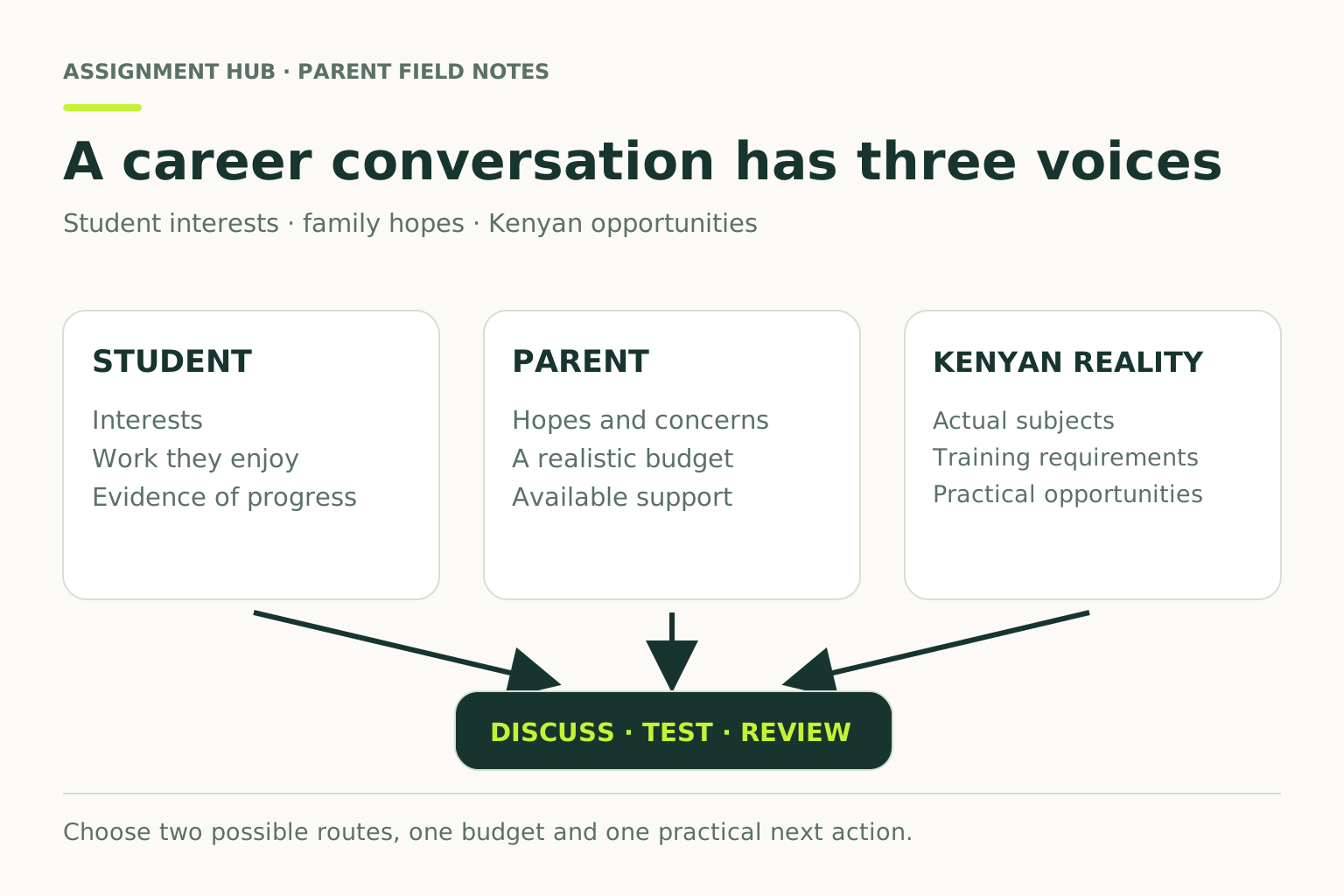
Start with three voices, not one decision-maker
Ask the student to name two activities they enjoy enough to practise when nobody is marking them, and request an example of work rather than a fashionable job title. Then ask the parent what they hope the route will provide: stability, service, independence or an opportunity they themselves did not have.
The third voice is reality: which subjects are offered, what later training requires and what the family can sustain. Write all three perspectives on one page, keeping disagreements visible so that a confident adult does not accidentally silence the learner’s evidence.
Use Grade 9 to build a shortlist
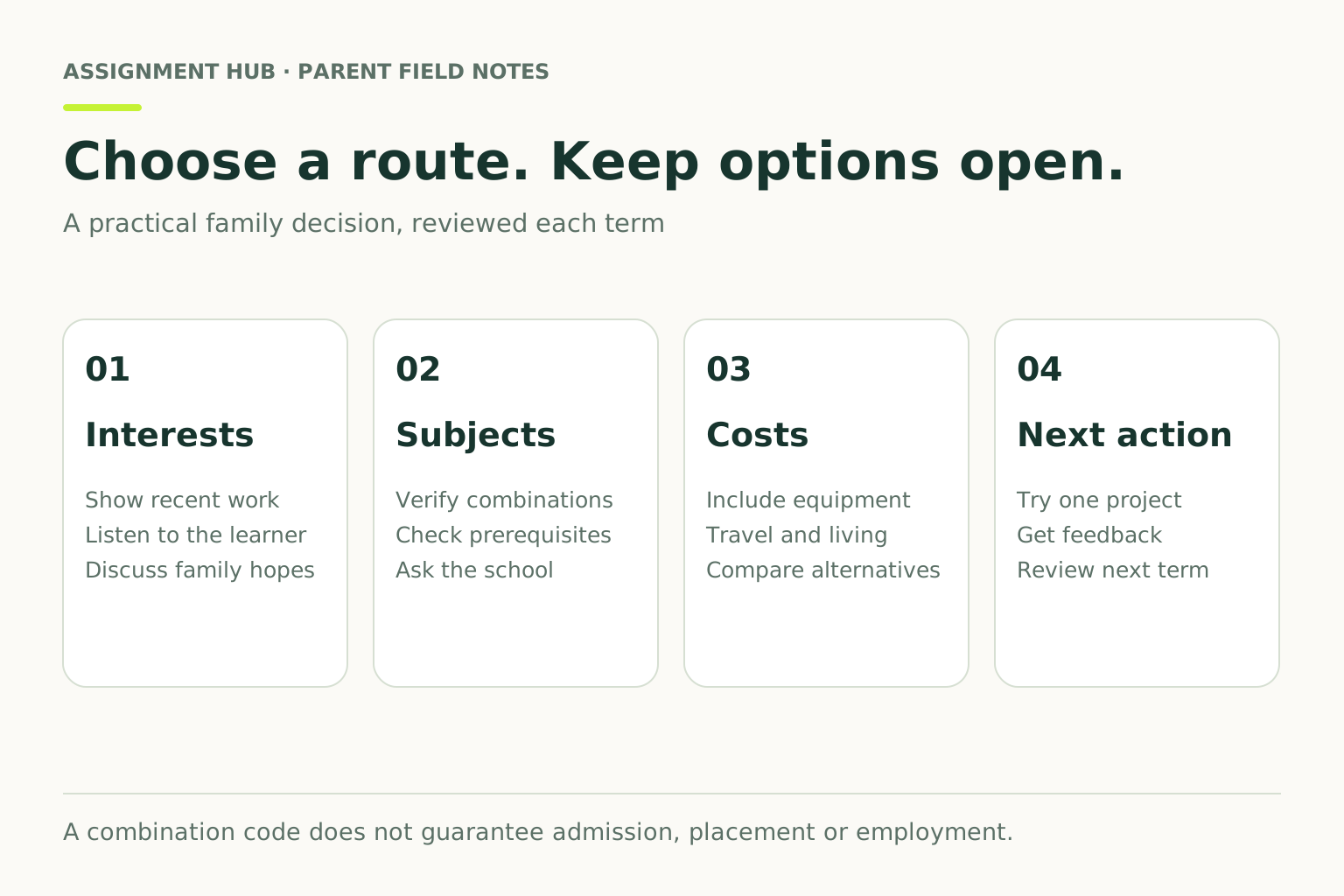
Before selection, compare two possible pathways using school feedback, recent work and the learner’s willingness to improve weaker foundations. A pupil who enjoys a science demonstration may also need to discover whether they enjoy measurement, repeated trials and explaining a result when the first prediction was wrong.
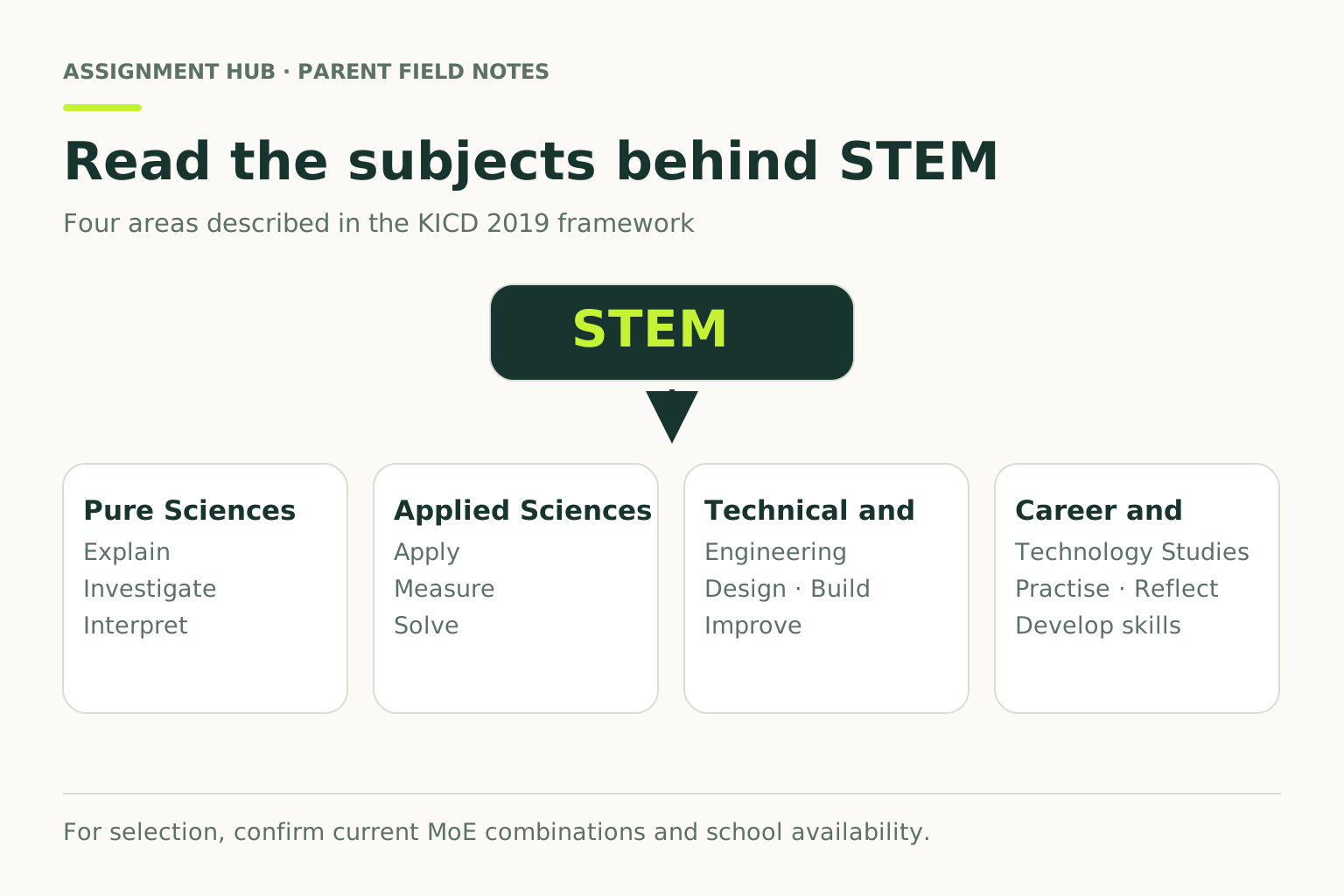
Ask the school about practical facilities, teaching provision and the combinations actually available, rather than assuming that a pathway name guarantees every subject. Our senior-school pathways guide explains why a broad STEM label is only the beginning of a useful comparison.
Read the subjects behind a combination code
A combination code identifies a particular set of subjects; it does not promise a school place, a degree or employment. For example, the owner-supplied portal catalogue records ST2056 as Agriculture, Aviation and Computer Studies, which should be verified against the current MoE portal before a formal selection.
Put the proposed combination beside the current requirements of two possible courses and ask which prerequisites it preserves. Check Mathematics carefully using the Core and Essential Mathematics guide, because assumptions about a subject name can close a door before the family has checked the actual rule.
Treat birth order and social class as conversation prompts
An eldest child may have been given responsibility at home, but that experience does not establish that management is their best career. Ask whether they enjoy leadership, what feedback they receive and whether another role would suit them better instead of converting a family position into a fixed identity.
Money affects transport, equipment, time and access to training, so discuss those constraints honestly without treating them as a measure of ambition. If a preferred route is expensive, investigate current funding, accredited alternatives and a staged plan before either promising affordability or dismissing the goal entirely.
Build a qualification-plus-skill route
Kenya’s informal economy makes practical capability relevant, but a national employment percentage cannot predict the earnings of a particular learner. Consider a hybrid plan such as computing study alongside an original portfolio, or agricultural training alongside supervised experience documenting a real growing project.
Keep the experiment small and safe: one completed task, feedback from a knowledgeable adult and a record of what the learner improved. The CSL project guide offers ways to observe planning and communication without claiming that unpaid service guarantees a job or replaces a qualification.
Review the plan through Grades 10–12
At the end of each term, compare the original reasons for choosing with new work, teacher feedback and the learner’s experience of the subjects. A difficult term calls for an investigation of foundations, workload and support; it does not automatically prove that the pathway was a mistake.
Keep a preferred route and a realistic alternative with the next requirement, estimated total cost and date checked for each. Career Compass can organise the conversation, while schools, accredited institutions and official selection processes remain responsible for current requirements and admission decisions.
Your next family meeting
- Bring recent work and two interests to discuss.
- Compare two verified subject combinations.
- List tuition, equipment, transport and living costs.
- Choose one practical skill experiment.
- Set a termly review date and a backup route.
Sources and practical resources
Questions parents ask
Should a parent choose the pathway?
Parents should help investigate options and costs while listening to the learner’s evidence and the school’s advice. A shared decision is more useful than choosing from fear or prestige alone.
Does being first-born predict a career?
No. Sibling position is not a validated career-selection test; use interests, work, feedback and actual requirements.
Is university the only successful route?
No. Compare accredited university, TVET and other suitable training routes against the intended work, costs and progression opportunities.
How This Connects to Your Child’s Career
A useful career plan connects subjects with entry requirements and a demonstrable skill. Career Compass helps structure that plan, but does not guarantee admission, placement or income.
Read the Career Compass guideRelated guides
STEM Pathways for Grade 10 Kenya: Subjects and Choices
Read the guide →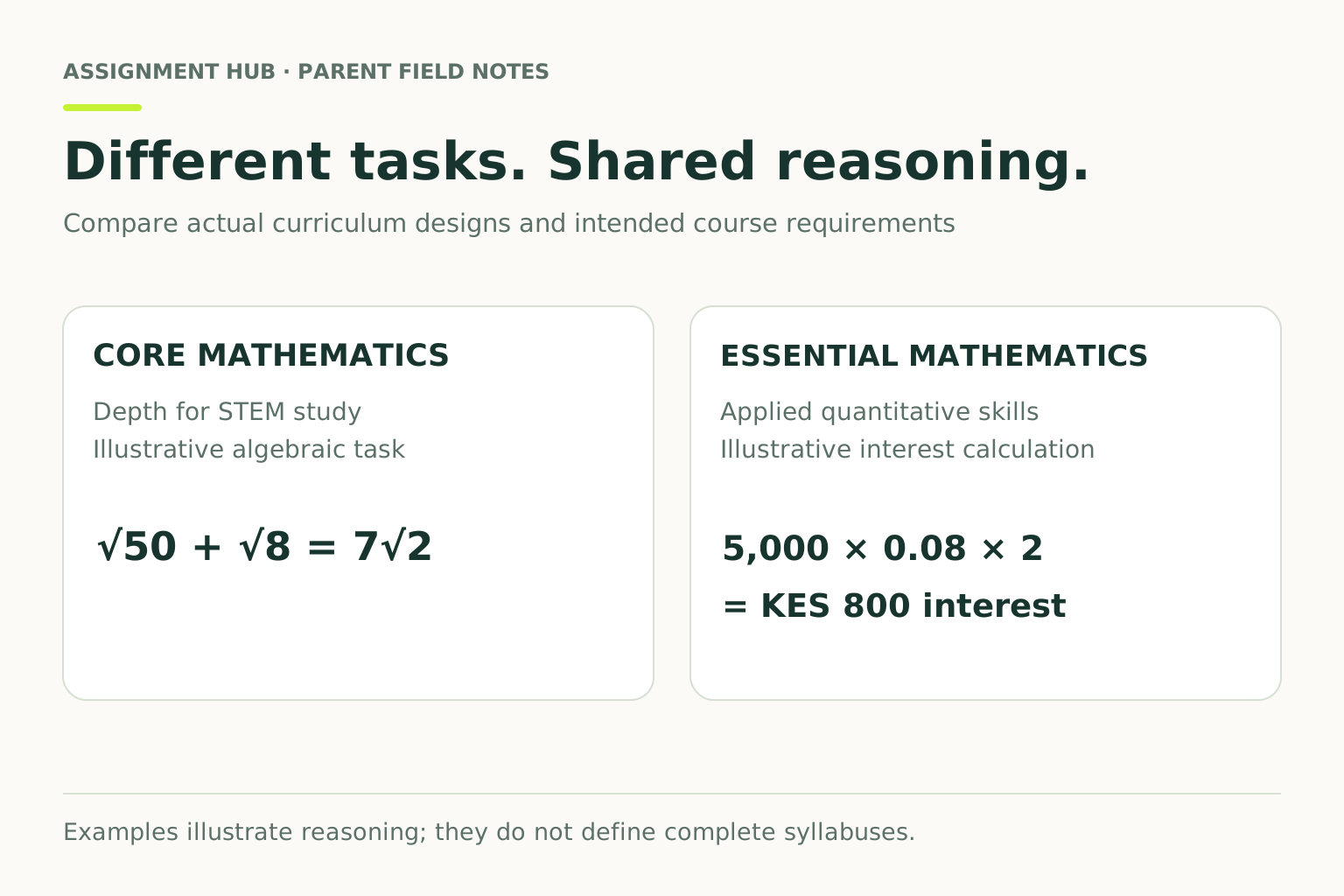
Core vs Essential Mathematics in Kenya: What's the Difference?
Read the guide →
CBC Grading System in Kenya: EE, ME, AE and BE Explained
Read the guide →